Friday, November 23, 2012

Steve Jobs' house burgled, thief pleads no contest


Steve Jobs' house burgled:

A California man accused of breaking into Steve Jobs' house and stealing computers and the Apple co-founder's wallet has pleaded no contest to burglarising homes across the San Francisco Bay area.
Kariem McFarlin accepted a plea deal and was convicted on Wednesday in Santa Clara County Superior Court on eight felony counts of residential burglary and one felony count of selling stolen property.
McFarlin was initially charged in August with one count each of residential burglary and selling stolen property after Jobs' Palo Alto home was broken into in July. He apparently didn't realise he was in Jobs' house until he saw a letter addressed to the Silicon Valley icon, who died in October 2011.
During the 15-hour overnight heist, McFarlin took the late Jobs' wallet and driver's license as well as iPhones, iPads, iPods, Mac computers, champagne and $60,000 worth of Tiffany jewelry, police said.
Investigators from a task force eventually linked the 35-year-old to seven other burglaries in Alameda, Marin and San Francisco dating back to March 2011, the San Jose Mercury News reported.
Prosecutors in those other counties agreed to resolve all of the burglary cases in Santa Clara County, said deputy district attorney Thomas Flattery, who filed an amended criminal complaint on Wednesday.
"I think it's a good outcome," Flattery said about McFarlin's no contest plea. "I think the case demonstrates a couple of things. Really, it's a good example of judicial economy and cooperation between the various counties to resolve everything at once.
"And it's also an example of the work a multi-jurisdictional task force can do to bring them all together."
McFarlin could face up to seven years and eight months in prison when he's scheduled for sentencing January 17.
He could have received a maximum of 16 years and four months behind bars, but Judge Thang Nguyen Barrett offered to cap the sentence at seven years and eight months in exchange for McFarlin's no contest plea, Flattery said.
Police previously said the Alameda resident confessed to breaking into Jobs' home.

Google indoor maps

Right around a year ago, Googleintroduced
 the first wave of indoor maps. Being able to locate yourself while trapped within concrete walls -- in places like concert halls, shopping malls, etc. -- has been a challenge for a long while, but leave it to a company like Google to figure out a workaround. Now, the company is bringing indoor maps to desktop web browsers. Previously, Google
's indoor mapping efforts were constrained to mobile. For now, Google's stepping gently into the new world. Only the main level of the available maps are available on the desktop, while multi-level buildings can be handled currently on the Android app. As of now, around 10,000 buildings are listed, and Google's working hard to expand things. Who said a ceiling had to come between you and your bearings? 

Kidspad

LG outs in Korea the Kidspad, a new Tablet design for kids and small Children. While LG did not release any technical details on this new Tablet, the company announced this morning in Korea that their engineers worked on the perfect digital companions for kids willing to bloom their curiosity and their mind with a set of educative tools and games and a dedicated App store that is totally Kid friendly with “parents” approved paid apps (yep you will have to pay to get some of these apps). Also LG insisted on several key points here including the usage of non-toxic materials, automatic brightness adjustment and strong reinforced body capable to withstand the worst!
The Kidspad will be sold in Korea this coming Wednesday.

AMD A-Series APUs now available in India

AMD A-Series APUs now available in India


AMD, the underdog of processors, has announced the availability of its new A-series Accelerated Processing Unit chips for the Indian market. The new processors will be priced between the Rs. 3,000-8,000 bracket and are being targeted at consumers who would like to do more with their PCs (or laptops) than just browse the web or make word files, without breaking the bank.
AMD A-Series APUs now available in IndiaAMD’s A-series APUs combine the power of multiple-core processing with the power of discrete graphics, all into one processor. AMD claims that these chips are not only power-efficient, but also pack in a decent punch as far as GPU capabilities go. Hoping that these new processors could replace a dedicated graphics card is obviously hoping for too much, but AMD says that they will definitely allow the casual gamer to indulge themselves in some fun activities.
AMD has always recognized the importance of the gaming community, which is a large and loud chunk of the computer using population. Their acquisition of ATI is testament of that and Ravi Swaminathan, Managing Director and Vice President-Sales and Marketing at AMD India furthered that belief at the launch when he acknowledged that “the world is moving around graphics and the APU is something accepted world over with better battery life (around 10 hours). We have launched the first generation APU a year ago and the new generation is an upgrade to it."
This is AMD bringing ATI’s graphics expertise to the game, shrinking it significantly and packing it into a processor. For example, the A10-5800K model, the top end A-series APU clocks the CPU at 3.8GHz (4 cores that can scale up to 4.2GHz) along with the power of the ATI Radeon HD7660. For a full list of the APU specs, head on over to this link.


iPad mini review

iPad mini review

ipad-mini-shopper-635.jpg

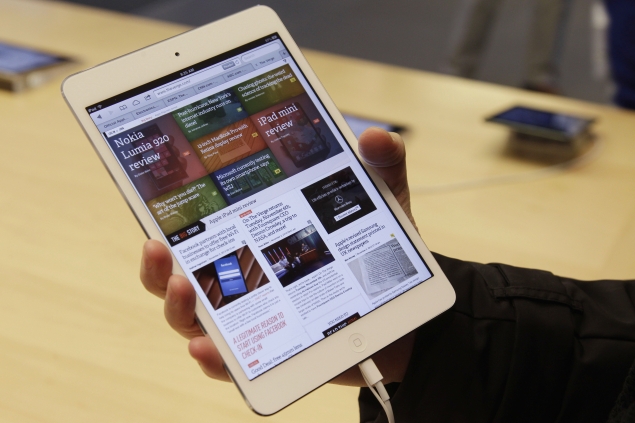
bet the iPad mini is going to be on a lot of wish lists this holiday season. I also bet that for a lot of people, it's not going to be the best choice. It's beautiful and light, but Apple made a big compromise in the design, one that means that buyers should look closely at the competition before deciding.
Starting at $329, the iPad mini is the cheapest iPad. The screen is a third smaller than the regular iPads, and it sits in an exquisitely machined aluminum body. It weighs just 11 ounces half as much as a full-size iPad making it easier to hold in one hand. It's just under 8 inches long and less than a third of an inch thick, so it fits easily into a handbag.
The issue is the screen quality. Apple has been on the forefront of a move toward sharper, more colorful screens. It calls them "Retina" displays because the pixels the little light-emitting squares that make up the screen are so small that they blend together almost seamlessly in our eyes, removing the impression that we're watching a grid of discrete elements.
The iPad mini doesn't have a Retina screen. By the standards of last year, it's a good screen, with the same number of pixels as the first iPad and the iPad 2. The latest full-size iPad has four times as many pixels, and it really shows. By comparison, the iPad mini's screen looks coarse. It looks dull, too, because it doesn't have the same color-boosting technology that the full-size model has.
This is not an entirely fair comparison, as the full-size iPad starts at $499 and weighs twice as much. The real issue is that this year, there are other tablets that are cheaper than the iPad mini, weigh only slightly more and still have better screens.
Amazon.com Inc.'s Kindle Fire HD costs $199 and has about the same overall size as the mini. While the Kindle's screen is somewhat smaller (leaving a bigger frame around the edges), it is also sharper, with 30 percent more pixels than the mini. Colors are slightly brighter, too.
Barnes & Noble Inc.'s Nook HD costs $229 and has a screen that's even sharper than the Kindle HD's. It's got 65 percent more pixels than the iPad mini.
Why do tablets from two companies chiefly known as book stores beat Apple's latest for screen quality?
Sharper screens are darker, requiring a more powerful backlight to appear bright. That, in turn, would have forced an increase in the battery size. That's the reason the first iPad with a Retina display was thicker and heavier than the iPad 2. So to keep the iPad mini thin while matching the 10-hour battery life of the bigger iPads, Apple had to compromise on the display.
This can't last, though. By next year, it will likely be even more obvious that Apple is seriously behind in screen quality on its small tablet, and it will have to upgrade to a Retina display somehow. That means this first-generation iPad mini will look old pretty fast.
The display causes a few other problems, too. One is that when you run iPhone apps on the mini, it uses the coarsest version of the graphics for that app - the version designed for iPhones up to the 2009 model, the 3GS. You can blow the app up to fill more of the screen, but it looks pretty ugly. The full-size iPad uses the higher-quality Retina graphics when running iPhone apps, and it looks much better.
Some apps adapted for the iPad screen don't display that well on the mini screen, either, because of the smaller size. Buttons can be too small to hit accurately, bringing to mind Steve Jobs' 2010 comments about smaller tablets. The late Apple founder was of the vociferous opinion that the regular iPad was the smallest size that was also friendly to use.
In some apps, text on the mini is too small to be comfortably read - the section fronts in The New York Times and The Wall Street Journal apps are examples of this.
Of course, in some other respects, the iPad mini outdoes the Fire and the Nook, so it isn't just the tablet for the buyer who needs the prettiest and the thinnest. In particular, the Mini is a $329 entry ticket to the wonderful world of iPad and iPhone apps. For quality and quantity, it beats all the other app stores. (Oddly, there's an inverse relationship between screen quality and app availability in this category the Nook HD has the best screen and the fewest apps, while the second-best Kindle Fire HD has middling access to apps.)
The Mini also has front- and back-facing cameras, for taking still photos and video and for videoconferencing. The Kindle Fire HD only has a front-facing camera for videoconferencing. The Nook HD doesn't have a camera at all.
In short, the iPad Mini is more versatile than the competition, and I'm sure it will please a lot of people. But take a look at the competition first, and figure that by next year, we'll see something from Apple that looks a lot better.
About the iPad Mini
The base model of the iPad mini costs $329 and comes with 16 gigabytes of storage. A 32 GB model goes for $429 and 64 GB for $529. Soon, you'll be able to get versions that can connect through cellular networks, not just Wi-Fi. Add $130 to the price.

Popular Posts